
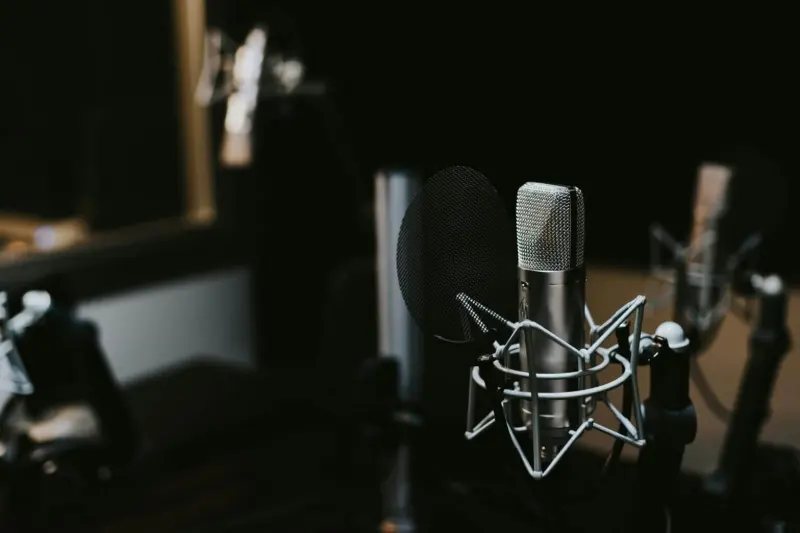
Most people planning a podcast spend weeks comparing microphones. The microphone matters, but it is rarely what makes a first podcast sound amateur. The room, the distance between your mouth and the mic, and how you edit make a bigger difference. This guide covers the podcast equipment you actually need, what it roughly costs in India, and when it makes more sense to book a studio instead of buying everything.
Three ways to record a podcast
Before buying anything, decide which of these you are:
- Testing the idea. Record two or three episodes on your phone with wired earphones in a quiet, furnished room. If you still enjoy it after three episodes, invest in gear.
- Committed solo host. One good microphone, headphones, and free editing software will take you a long way.
- Interview or video podcast. Two or more people, sometimes on camera. This is where costs, setup time, and sound problems multiply, and where a studio often works out cheaper.
The essential podcast equipment
1. Microphone: dynamic, not condenser (for most homes).
Condenser mics are very sensitive and pick up everything: the fan, traffic, and the echo of your walls. They sound great in a treated studio and poor in a normal bedroom. Dynamic mics mostly pick up what is right in front of them, which makes them far more forgiving at home. For a first podcast, a dynamic mic is the safer choice.
You’ll also choose between USB and XLR:
- USB mics plug straight into your laptop. Simple, cheaper, and ideal for solo shows.
- XLR mics need an audio interface or mixer, but they sound better, last longer, and let you record two or more people on separate tracks.
Some popular mics offer both USB and XLR outputs, so you can start simple and upgrade later without replacing the mic.
2. Closed-back headphones.
Wear headphones while you record so you hear problems as they happen: a plosive “p”, a clipped laugh, a fan you’d stopped noticing. Closed-back headphones keep sound from leaking into the mic. Avoid wireless earbuds for monitoring; the delay makes it hard to hear yourself naturally.
3. Audio interface (only for XLR mics).
An audio interface converts the mic signal for your computer. A two-input interface is enough for a host and one guest. For regular three- or four-person episodes, look at a podcast mixer with more inputs.
4. Mic arm, pop filter, and cables.
A desk-mounted boom arm keeps the mic at a steady distance from your mouth, which keeps your volume steady too. A foam windscreen or pop filter softens hard “p” and “b” sounds.
5. The room.
Hard, empty rooms create echo that no microphone can fix. Record in the most furnished room you have: curtains, a bed, a sofa, bookshelves, and carpets all absorb reflections. Avoid windows facing the road, and switch off fans and ACs while recording.
6. Recording and editing software.
Audacity is free on Windows and Mac, GarageBand is free on Mac, and paid editors like Adobe Audition or Reaper help once you edit every week. For interviews, record each person on a separate track.
7. For video podcasts: camera and lights.
Video podcasts are huge on YouTube in India. Two recent phones on tripods can work as cameras, but lighting matters more than the camera: two soft LED panels make an ordinary room look professional. Every camera angle adds editing time.
Budget ranges for podcast equipment in India
Prices change often and vary between sellers, so treat these as rough ranges (late 2026), not quotes:
| Setup | What it includes | Rough budget |
| Phone test | Your phone, wired earphones, a quiet furnished room, free editing app | ₹0 – ₹1,000 |
| Solo starter | USB dynamic mic, closed-back headphones, mic arm, foam windscreen | ₹6,000 – ₹25,000 |
| Two-person audio | 2 XLR dynamic mics, 2-input interface, 2 headphones, 2 mic arms, cables | ₹25,000 – ₹75,000 |
| Add video | Tripods and 2 LED lights (using phones you own) | + ₹5,000 – ₹20,000 |
Room treatment is extra. Acoustic panels for one room can cost more than the microphone, which is why furnishing and positioning matter so much at home.
Five beginner mistakes to avoid
1. Buying a condenser mic for an untreated room. It captures the room more than your voice.
2. Sitting too far from the mic. Roughly a hand’s width works for most dynamic mics.
3. Recording too loud. Distortion from levels hitting the red can’t be fixed in editing.
4. Not recording a test. Record 30 seconds and listen back before every session.
5. Keep only one copy. Back up raw recordings before you edit.
Home setup vs renting a podcast studio
| Home setup | Podcast studio | |
| Upfront cost | ₹6,000 – ₹75,000+ in gear | Pay per session, no gear to buy |
| Sound | Depends on your room | Treated room, consistent every episode |
| Guests | Need extra mics and space | Multiple mics ready |
| Editing | You learn and do it yourself | Can be done for you |
| Best for | Weekly solo shows, flexible timing | Interviews, pilot episodes, video, brand podcasts |
Many creators combine both: solo episodes at home, and a studio for guest interviews, video episodes, or a polished first season.
Callout box:
Recording in Noida? Our podcast studio in Noida (Greater Noida West) has an acoustically treated room, with recording, editing, and mixing in one place. Sessions start from ₹1,500.
Frequently Asked Questions (FAQs)
Q1: Which microphone is best for a beginner podcast in India?
A: For most home setups, a dynamic microphone, because it picks up less room echo and noise than a condenser. A USB dynamic mic is the simplest start for a solo show; choose XLR if you plan to record guests.
Q2: Do I need an audio interface for a podcast?
A: Only for XLR microphones. USB mics connect directly to your computer.
Q3: Can I start a podcast with just my phone?
A: Yes. Record in a quiet, furnished room with the phone close to your mouth, and use free editing software.
Q4: How much does a podcast studio cost in Noida?
A: At Jatin Arora Music Studio in Greater Noida West, podcast sessions start at ₹1,500, with recording, editing, and mixing in one place.